Mercury
Mercury is the smallest and closest planet to the Sun in the Solar System. Its orbit around the Sun takes 87.97 Earth days, the shortest of all the planets in the Solar System. It is named after the Roman god Mercurius (Mercury), god of commerce, messenger of the gods, and mediator between gods and mortals, corresponding to the Greek god Hermes (Ἑρμῆς).
Like Venus, Mercury orbits the Sun within Earth's orbit as an inferior planet, and its apparent distance from the Sun as viewed from Earth never exceeds 28°. This proximity to the Sun means the planet can only be seen near the western horizon after sunset or the eastern horizon before sunrise, usually in twilight. At this time, it may appear as a bright star-like object, but is often far more difficult to observe than Venus. The planet telescopically displays the complete range of phases, similar to Venus and the Moon, as it moves in its inner orbit relative to Earth, which recurs over its synodic period of approximately 116 days.
Mercury rotates in a way that is unique in the Solar System. It is tidally locked with the Sun in a 3:2 spin-orbit resonance,[16] meaning that relative to the fixed stars, it rotates on its axis exactly three times for every two revolutions it makes around the Sun.[a][17] As seen from the Sun, in a frame of reference that rotates with the orbital motion, it appears to rotate only once every two Mercurian years. An observer on Mercury would therefore see only one day every two Mercurian years.

(photo caption)
Venus
Venus is the second planet from the Sun. It is named after the Roman goddess of love and beauty. As the brightest natural object in Earth's night sky after the Moon, Venus can cast shadows and can be, on rare occasion, visible to the naked eye in broad daylight.[15][16] Venus lies within Earth's orbit, and so never appears to venture far from the Sun, either setting in the west just after dusk or rising in the east a little while before dawn. Venus orbits the Sun every 224.7 Earth days.[17] With a rotation period of 243 Earth days, it takes longer to rotate about its axis than any other planet in the Solar System by far, and does so in the opposite direction to all but Uranus (meaning the Sun rises in the west and sets in the east).[18] Venus does not have any moons, a distinction it shares only with Mercury among the planets in the Solar System.[19]
Venus is a terrestrial planet and is sometimes called Earth's "sister planet" because of their similar size, mass, proximity to the Sun, and bulk composition. It is radically different from Earth in other respects. It has the densest atmosphere of the four terrestrial planets, consisting of more than 96% carbon dioxide. The atmospheric pressure at the planet's surface is about 92 times the sea level pressure of Earth, or roughly the pressure at 900 m (3,000 ft) underwater on Earth. Venus has, by far, the hottest surface of any planet in the Solar System, with a mean temperature of 737 K (464 °C; 867 °F), even though Mercury is closer to the Sun. Venus is shrouded by an opaque layer of highly reflective clouds of sulfuric acid, preventing its surface from being seen from space in visible light. It may have had water oceans in the past,[20][21] but these would have vaporized as the temperature rose due to a runaway greenhouse effect.[22] The water has probably photodissociated, and the free hydrogen has been swept into interplanetary space by the solar wind because of the lack of a planetary magnetic field.[23] Venus' surface is a dry desertscape interspersed with slab-like rocks and is periodically resurfaced by volcanism.

(photo caption)
Earth
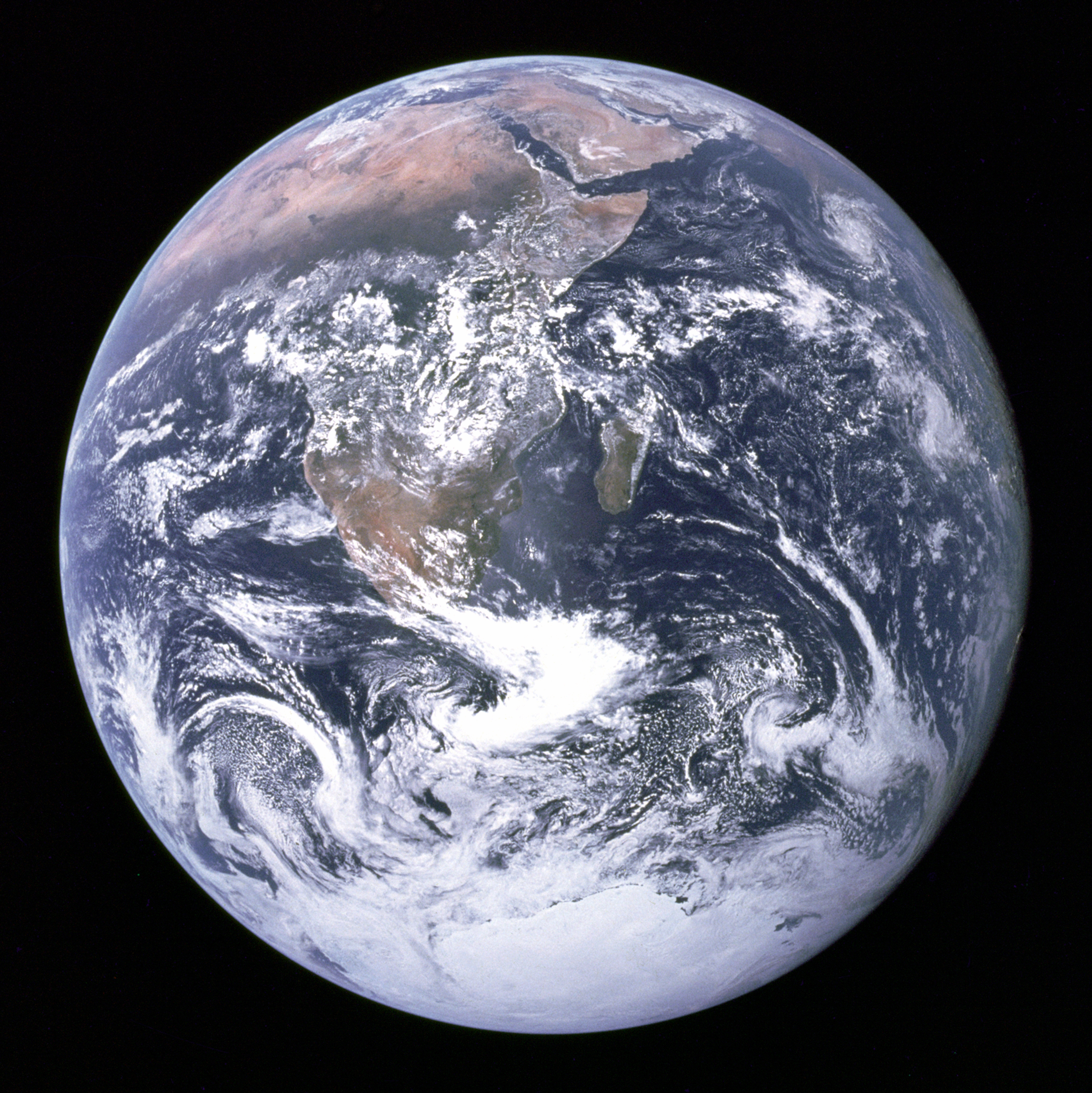
Earth is the third planet from the Sun and the only astronomical object known to harbor life. About 29% of Earth's surface is land consisting of continents and islands. The remaining 71% is covered with water, mostly by oceans, seas, gulfs, and other salt water bodies, but also by lakes, rivers, and other fresh water, which together constitute the hydrosphere. Much of Earth's polar regions are covered in ice. Earth's outer layer is divided into several rigid tectonic plates that migrate across the surface over many millions of years. Earth's interior remains active with a solid iron inner core, a liquid outer core that generates Earth's magnetic field, and a convecting mantle that drives plate tectonics.
Earth's atmosphere consists mostly of nitrogen and oxygen. More solar energy is received by tropical regions than polar regions, and is redistributed by atmospheric and ocean circulation. Greenhouse gases also play an important role in regulating the surface temperature. A region's climate is not only determined by latitude, but also by elevation, and by proximity to moderating oceans, among other factors. Extreme weather, such as tropical cyclones and heat waves, occurs in most areas and has a large impact on life.
(photo caption)
(All information borrowed from Wikipedia)